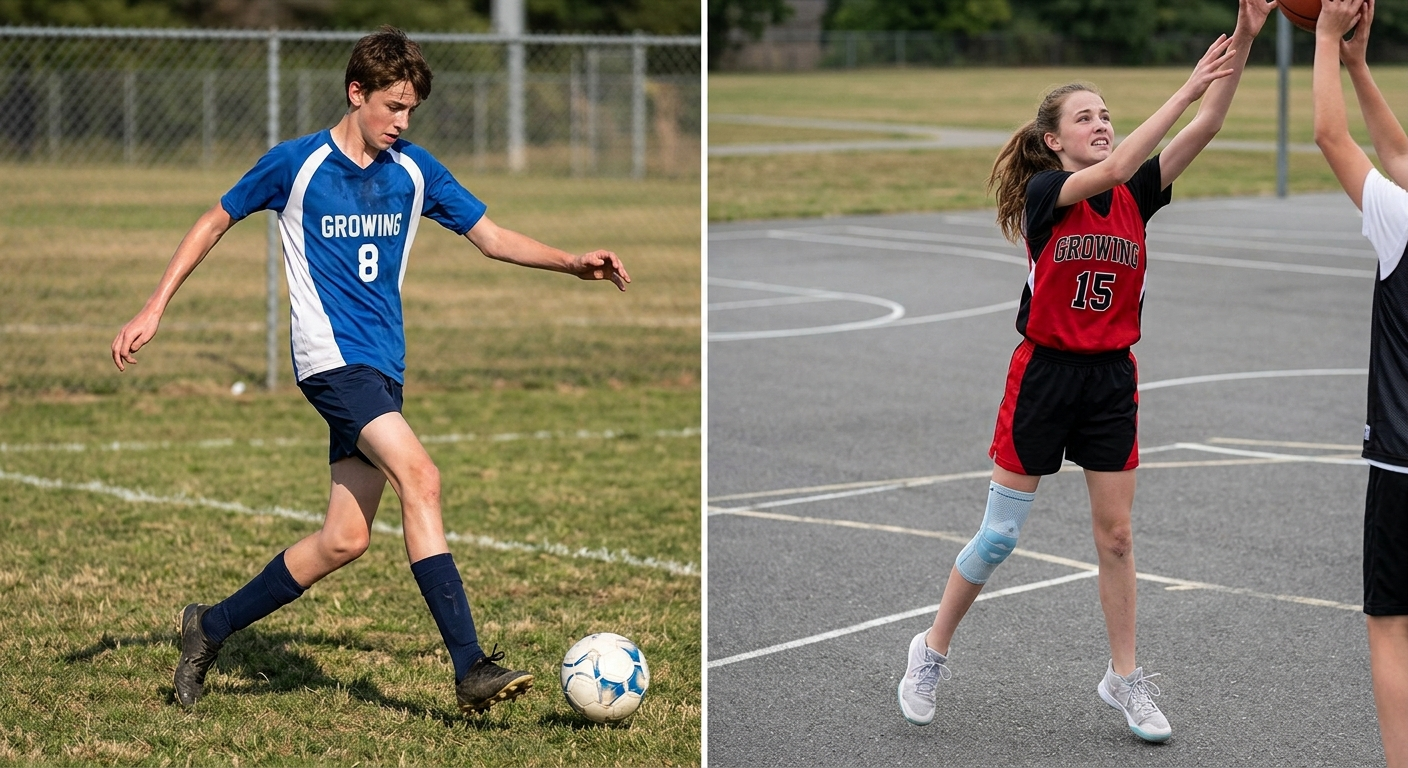
Somewhere this fall, your kid stopped being the one who beat you to the car on practice days. The cleats sit by the door a little longer. The ride home runs quiet, or short-tempered. You’ve put real money, real weekends, and years of work into helping this child love a game, and now some of that fire looks like it’s fading.
Most parents file that under motivation. Sometimes it belongs there. More often than we’d guess, the first thing to check is the clock.
The clocks went back this weekend, which makes this the right week to check it.
What a 12-year-old actually needs
The American Academy of Sleep Medicine convened a panel that reviewed 864 published studies. Its recommendation: nine to twelve hours of sleep for children six to twelve, and eight to ten for ages thirteen to eighteen, on a regular basis (Paruthi et al., 2016). Most of that evidence is observational. It shows association, not cause. It’s still the best map we have.
Run the math at your house. Take your child’s school-day wake time and count back nine hours. A 6:45 alarm means lights out by 9:45 to reach the low end of the range. Now check how close your evenings run to that number.
Tired looks a lot like unmotivated
Researchers have tested this. In one trial, teens aged 14 to 17 spent five nights with 6.5 hours in bed and five nights with ten. After the short nights, both the teens and their parents reported more irritability and weaker emotional regulation (Baum et al., 2014). In another experiment, 13 to 17 year olds slept four hours one night and nine and a half on another. After the short night they reported lower positive mood and higher anxiety (Reddy et al., 2017). A 2021 meta-analysis found that sleep deprivation had a large effect on lowering positive emotion, and that sleep restriction produced a small decline in adaptive emotion regulation, in studies done entirely with young people (Tomaso et al., 2021).
None of those studies measured drive. They measured mood, irritability, and self-regulation, which is exactly what a parent sees and calls attitude or lost interest. That link is my reading of the evidence, and most of these experiments used older teens, so applying them to a 12-year-old is an extrapolation. It’s a reasonable one, and it costs nothing to test.
The Body shows it too. In a survey of 112 middle and high school athletes, those averaging under eight hours a night were significantly more likely to be injured (Milewski et al., 2014). A 2019 systematic review and meta-analysis pointed the same direction for chronic short sleep and found the evidence on a single bad night insufficient (Gao et al., 2019). Both are associations. They fit what we see at R1 Ready First: Energy qualifies Mind and Body. It sets the ceiling on what a child can do with either one on a given day.
That framing runs through the Energy domain that Dr. Richard Swinbourne, PhD, our co-founder and Energy lead, helped build. Sleep sits alongside hydration and fueling in that domain, and it’s the one this week’s clock change puts in front of us.
Why a 12-year-old can’t just go to bed earlier
Adolescent biology pulls the clock later. In a study that followed 94 adolescents for about two and a half years, sleep timing and the body’s melatonin onset both drifted later with age (Crowley et al., 2014).
Light drives a lot of that. In a lab study of children and adolescents aged 9 to nearly 16, those in early to mid puberty lost about 9 percent of their melatonin to one hour of light at 15 lux, which is dim light. They lost 26 percent at 150 lux and 37 percent at 500 lux, and they were more sensitive than kids further along in puberty. The 15 lux result stood out because that level doesn’t usually suppress melatonin in adults (Crowley et al., 2015).
Screens add to the load. In a small controlled study, 12 adults read from a light-emitting tablet for four hours before bed across five nights, and on other nights read a printed book. The tablet cut melatonin by more than half, pushed the body clock back about an hour and a half, added about ten minutes to the time it took to fall asleep, and left people less alert the next morning (Chang et al., 2015). Those were adults. Kids in early puberty respond to evening light more strongly than older teens, so the concern points the same direction for a 12-year-old.
Weekends matter too. In a small lab study of older teens, a late weekend sleep schedule delayed the body clock (Crowley & Carskadon, 2010). Monday morning starts from behind before the alarm rings.
The Week-One Reset
Here’s what the research can and can’t say. Light alone isn’t a silver bullet. In one study of high school seniors, morning bright light didn’t change their sleep or their daytime performance (Hansen et al., 2005). The strongest recent evidence pairs light with structure. A 2026 randomized trial in JAMA Pediatrics gave 16 to 19 year olds with late bedtimes a personalized sleep schedule, morning bright-light glasses, and evening blue-light-blocking glasses for two weeks. Weeknight sleep grew by about 47 minutes (Wescott et al., 2026; AJMC, 2026). The plan below borrows that logic: light in the right places, a fixed schedule, and a calmer evening.
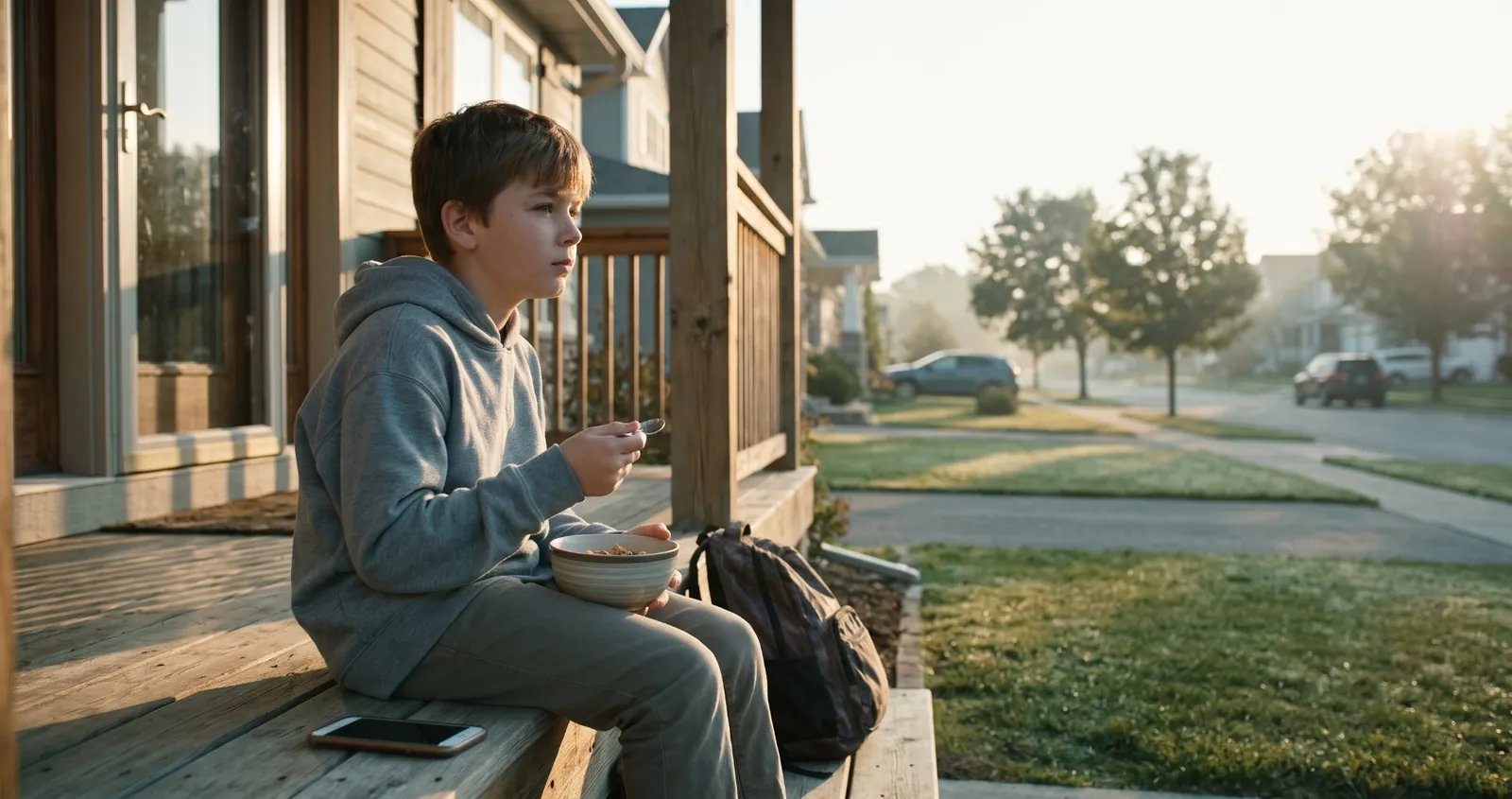
Morning: light before screens. Get your child outside within the first hour after waking. Eat breakfast on the porch, walk to school, or do the dog loop. Outdoor daylight, even on an overcast morning, is several times brighter than a lit room. The phone waits until after the porch. The first light your child’s clock sees should be the brightest light of the day.
After school: afternoon sunlight. Put your child in daylight before sunset, and build it into something that already happens, like outdoor practice, the walk home, or play in the yard. In small studies of adults, bright daytime light was linked to more slow-wave sleep (Wams et al., 2017) and less melatonin suppression from light at night (Kozaki et al., 2015). Those were adults, so treat this as a low-cost habit with good logic behind it and no promise of results. Sunset now comes before five o’clock in places like Chicago and New York, which shrinks the window and gives that outdoor time more weight than it had last week.
Evening: dim the house and park the devices. An hour or two before bed, switch from overhead lights to lamps. Keep screens out of the bedroom, and turn them off for the last hour. Water is the default drink. The American Academy of Pediatrics says the caffeine and other stimulants in energy drinks have no place in the diet of children and adolescents (Schneider & Benjamin, 2011). A tired kid needs sleep. A stimulant only covers the tiredness.
Bedtime: one time, every night. Set it by counting back from the wake time, then hold it. The AASM recommendation is for those hours on a regular basis (Paruthi et al., 2016), and a fixed time gives your child’s body a clear signal to follow.
Weekends: protect Sunday night. Keep weekend wake-up close to the school-day time, and get the morning light in on both days. In a trial of 14 to 17 year olds who were short on sleep on school nights, weekend morning bright light plus evening time management moved body-clock timing earlier and extended weeknight sleep (Crowley et al., 2023). Mondays go better when Sunday night did its job.
Day seven: check the kid in front of you. After a week, look at the mood on the car ride home, the speed of the morning, and the energy at practice. You’ll have a before and after on the same child. That comparison is the difference between hope performance and known performance.
R1’s daily check-in asks when your child went to bed and woke up, how fast they fell asleep, how well they slept, and whether they put their technology away before sleep. The Energy domain logs water and meals alongside it, then connects what it finds to Mind and Body, so a family sees the pattern instead of guessing at it.
Pick one thing tonight. Move the phone out of the bedroom, or plan breakfast on the porch tomorrow. Small and specific beats ambitious and abandoned, and a week from now you’ll know more about your kid’s energy than you did this morning.
This article offers general, evidence-informed information and does not replace medical advice. If your child snores loudly, struggles to fall asleep for weeks, or seems exhausted despite getting enough hours, talk with your pediatrician.
Paruthi S, Brooks LJ, D’Ambrosio C, et al. (2016). Recommended amount of sleep for pediatric populations: a consensus statement of the American Academy of Sleep Medicine. Journal of Clinical Sleep Medicine, 12(6), 785-786. doi:10.5664/jcsm.5866. Review methodology: J Clin Sleep Med, 12(11), 1549-1561. doi:10.5664/jcsm.6288.
Baum KT, Desai A, Field J, Miller LE, Rausch J, Beebe DW. (2014). Sleep restriction worsens mood and emotion regulation in adolescents. Journal of Child Psychology and Psychiatry. PMID 24889207.
Reddy R, Palmer CA, Jackson C, Farris SG, Alfano CA. (2017). Impact of sleep restriction versus idealized sleep on emotional experience, reactivity and regulation in healthy adolescents. Journal of Sleep Research, 26(4), 516-525.
Tomaso CC, Johnson AB, Nelson TD. (2021). The effect of sleep deprivation and restriction on mood, emotion, and emotion regulation: three meta-analyses in one. Sleep, 44(6), zsaa289. doi:10.1093/sleep/zsaa289.
Milewski MD, Skaggs DL, Bishop GA, et al. (2014). Chronic lack of sleep is associated with increased sports injuries in adolescent athletes. Journal of Pediatric Orthopaedics, 34(2), 129-133. doi:10.1097/BPO.0000000000000151.
Gao B, Dwivedi S, Milewski MD, Cruz AI Jr. (2019). Lack of sleep and sports injuries in adolescents: a systematic review and meta-analysis. Journal of Pediatric Orthopaedics, 39(5), e324-e333. doi:10.1097/BPO.0000000000001306.
Crowley SJ, Van Reen E, LeBourgeois MK, et al. (2014). A longitudinal assessment of sleep timing, circadian phase, and phase angle of entrainment across human adolescence. PLoS One, 9(11), e112199. doi:10.1371/journal.pone.0112199.
Crowley SJ, Cain SW, Burns AC, Acebo C, Carskadon MA. (2015). Increased sensitivity of the circadian system to light in early/mid-puberty. Journal of Clinical Endocrinology & Metabolism, 100(11), 4067-4073. doi:10.1210/jc.2015-2775.
Chang AM, Aeschbach D, Duffy JF, Czeisler CA. (2015). Evening use of light-emitting eReaders negatively affects sleep, circadian timing, and next-morning alertness. Proceedings of the National Academy of Sciences, 112(4), 1232-1237. doi:10.1073/pnas.1418490112.
Crowley SJ, Carskadon MA. (2010). Modifications to weekend recovery sleep delay circadian phase in older adolescents. Chronobiology International, 27(7), 1469-1492.
Hansen M, Janssen I, Schiff A, Zee PC, Dubocovich ML. (2005). The impact of school daily schedule on adolescent sleep. Pediatrics, 115(6), 1555-1561. PMID 15930216.
Wescott DL, Quick AD, Oryshkewych NS, et al. (2026). Chronotherapeutic approaches to target insufficient and late sleep in adolescents: a randomized clinical trial. JAMA Pediatrics. Published online April 20, 2026. doi:10.1001/jamapediatrics.2026.0976.
AJMC (April 27, 2026). Light-based chronotherapy advances circadian timing, extends sleep in late-sleeping adolescents. Coverage of Wescott et al. (2026).
Crowley SJ, et al. (2023). Extending weeknight sleep of delayed adolescents using weekend morning bright light and evening time management. Sleep, 46(1), zsac202. doi:10.1093/sleep/zsac202.
Wams EJ, Woelders T, Marring I, et al. (2017). Linking light exposure and subsequent sleep: a field polysomnography study in humans. Sleep, 40(12), zsx165. doi:10.1093/sleep/zsx165.
Kozaki T, et al. (2015). Effects of day-time exposure to different light intensities on light-induced melatonin suppression at night. Journal of Physiological Anthropology, 34, 27.
Schneider MB, Benjamin HJ; American Academy of Pediatrics. (2011). Sports drinks and energy drinks for children and adolescents: are they appropriate? Pediatrics, 127(6), 1182-1189.
See Energy next to Mind and Body.
R1 reads sleep every day, so you see the pattern in your child instead of guessing at it.