Your child’s readiness is linked to their confidence, physical capability, and how well they fuel their mind and body.
Readiness is a skill that can be built with the right information tailored to your child’s developmental needs.
This isn’t a grade or a score, it is a picture of where your child is, with a plan for what to do to get them where they need to be to thrive.
Helping you understand and develop your child’s readiness so they can thrive, not just survive, is our mission.
Our development framework has been cultivated over decades of working and applying best practices for the Mind, Body, and Energy to help athletes win on the world stage. We have learned there is no bad developmental state. There is just their current state of being and how well that supports their daily demands.
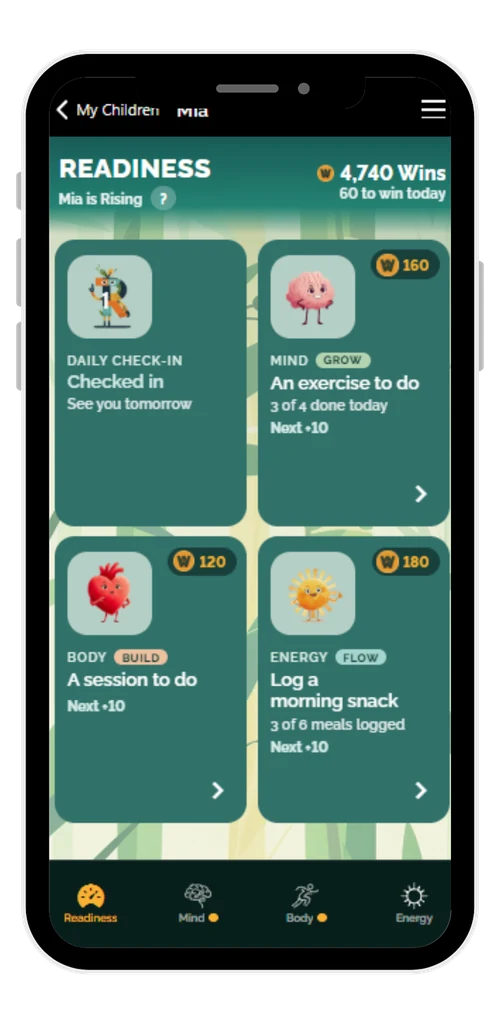
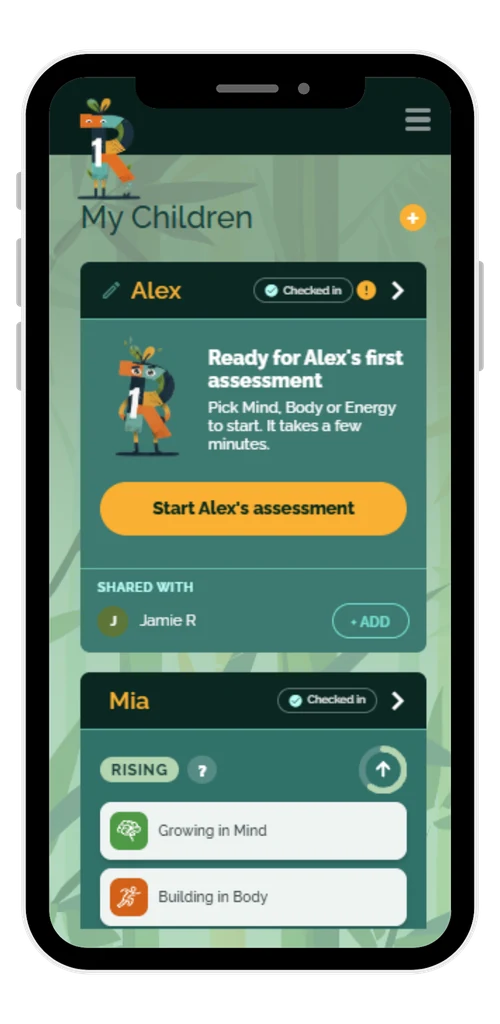
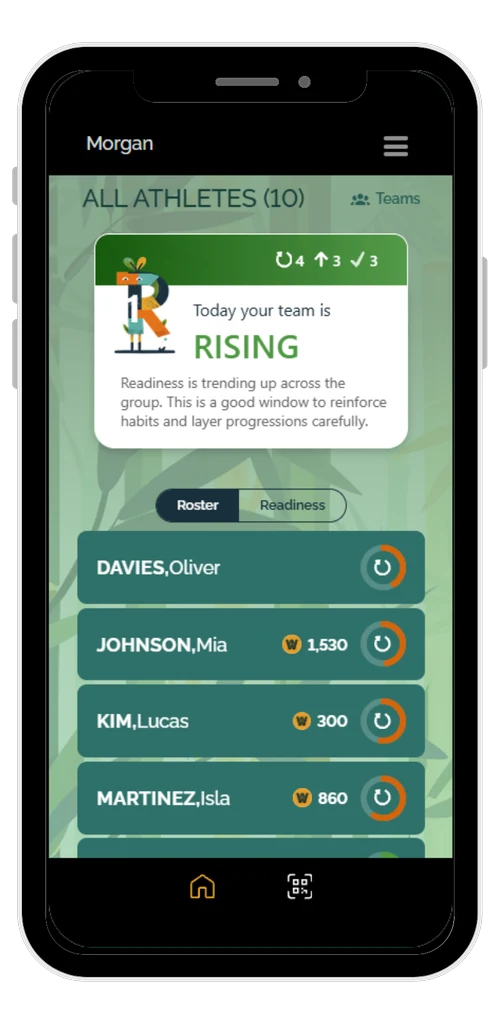
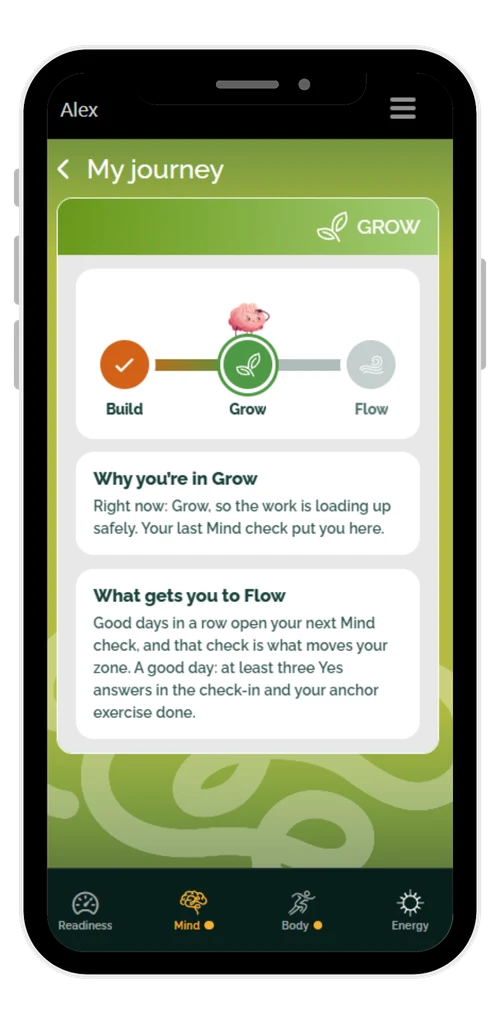
Our system looks at how the Mind, Body, and Energy integrate to form your child’s overall Meta-State, which we classify as either Rebuilding, Rising, or Ready.
The intent was never the problem. The information was. No adult around a child has ever been able to see the Mind, the Body, and the Energy at the same time.
Right now, all of it only becomes visible after something breaks.
The injury that ends a season. The confidence that never quite comes back. The child who quietly decides they are done and never says why. By the time any of that surfaces, nobody is developing a child anymore. Everyone is managing damage.
R1 puts the same picture in front of the parent, the coach, and the club while there is still time to do something with it.
Coaching a team or running a club? See what this looks like across a roster →
One system, not three apps. Follow one day with R1 for Alex.
R1 starts as something you do with your child and becomes something they drive themselves. The handover is the development.
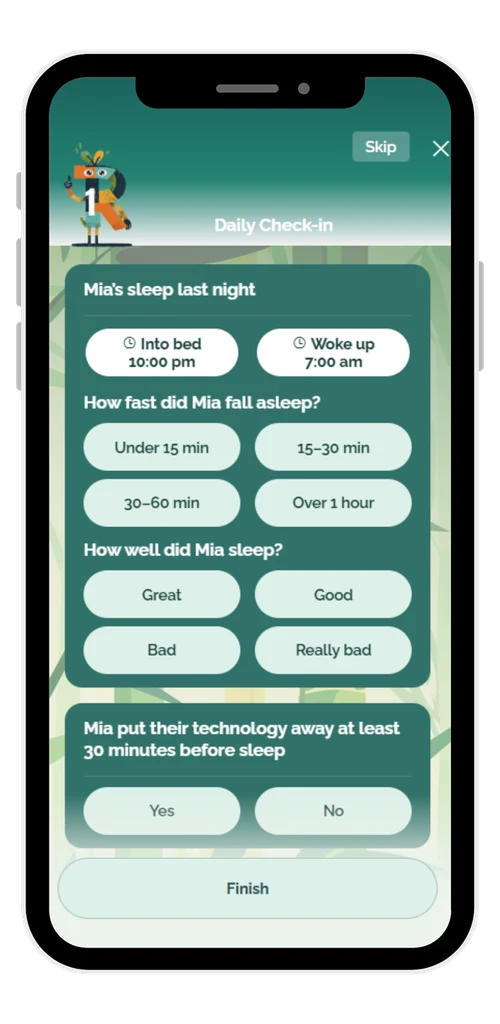
You and your child complete the daily check-in together. The questions are designed to be answered through observation, not interrogation.
Adolescence is the handover. Your child begins driving their own check-in and their own development. You still see the full picture and keep every privacy control.
Their readiness, their autonomy. Still parent-linked until 18, but by now the development is theirs. That was the point all along.
Development is like the tides: some days are high and some are low. R1 helps you support your child through the ebbs and flows of development.
The child does the work. The bars move because they did.
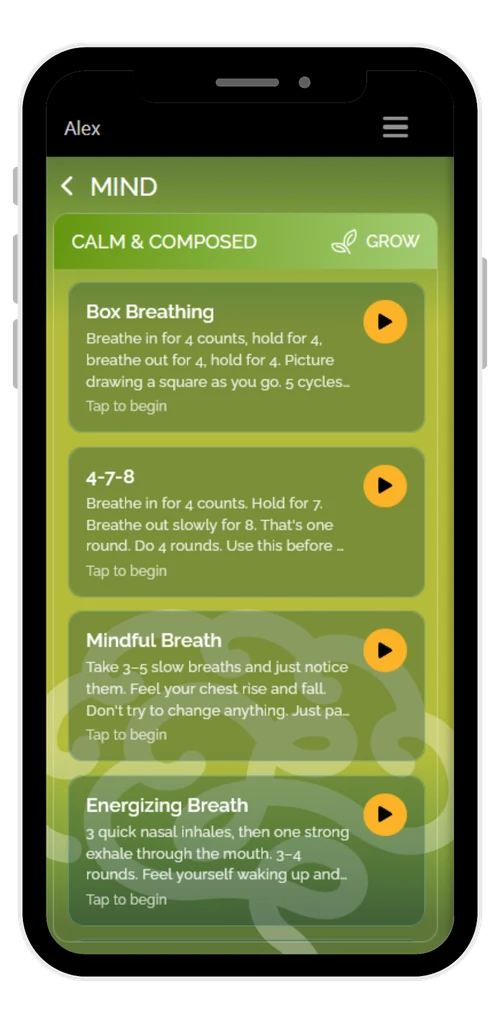
Guided imagery, paced breathing, structured journaling. The tools mental performance coaches use with Olympians, sized for a ten-year-old’s day and targeted to what today’s check-in surfaced.
Every exercise they finish earns a personal Win, and those Wins build their Mind total.
R1 catches this
Capability is earned in order. Nothing arrives before the child is ready. Control builds capability. Capability builds confidence.
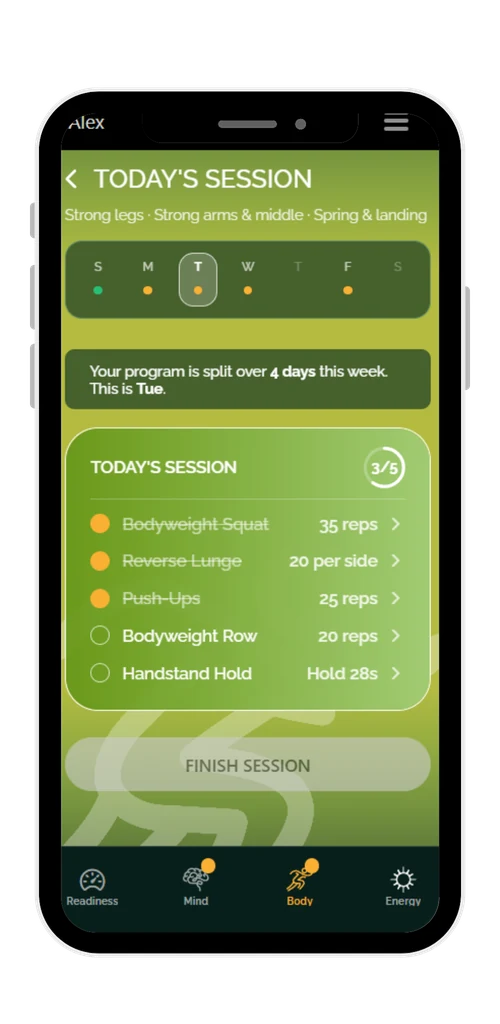
Every session comes from a doctorate spent on one problem: how young athletes learn to move well, produce power safely, and avoid the injuries that end seasons. Olympic movement standards, suitable for all ages.
Every session they complete earns a personal Win, added to their Body total.
R1 catches this
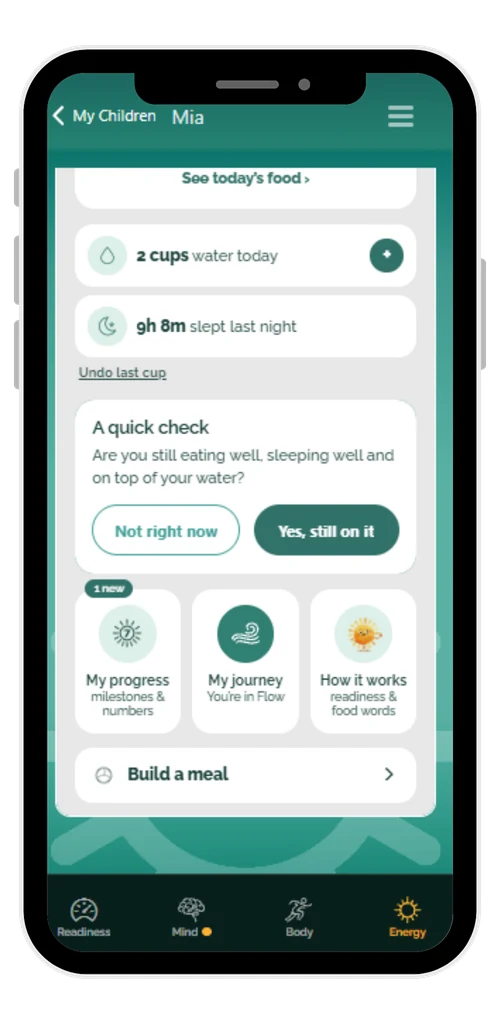
A better breakfast, one more cup of water, a bedtime kept. Small choices, made visible, compound into readiness a child can feel.
Every choice is Great, Good, or Fun, and Fun belongs in a childhood. Children learn by exploring and understanding, not by being told no. You can’t do a don’t. Behavior built on negatives doesn’t hold. Awareness does.
Logging sleep, food, and water earns Wins too, and shows your child whether their choices are helping or hurting.
R1 catches this
The tools are established, not experimental. Meta-analytic evidence supports imagery training for skill and performance (Simonsmeier et al., 2021). Slow-paced breathing reliably regulates the nervous system (Zaccaro et al., 2018). Reflective writing improves self-regulation and confidence (Pennebaker’s expressive-writing research). Youth resistance training follows American Academy of Pediatrics clinical guidance. Sleep targets follow the American Academy of Sleep Medicine consensus for children and teens (Paruthi et al., 2016), and adolescent athletes sleeping less than eight hours a night show significantly higher injury rates (Milewski et al., 2014). Fueling and hydration guidance follows the joint position of the Academy of Nutrition and Dietetics, Dietitians of Canada, and the American College of Sports Medicine (Thomas et al., 2016).
Every user sees what they need, framed for how they think, and every view is built to teach, not just report. The privacy architecture isn’t a policy. It’s a feature.


The full picture
Daily readiness state, the Mind, Body, and Energy breakdown, trends over time, early warning signals, and full privacy controls.
You control what coaches and organizations can see.
Readiness state only
A team roster with readiness badges, and session-specific guidance per athlete in their own coaching style.
No raw scores. No personal or sensitive information.
Their state, programming, and tools
Their own readiness state, daily programming, and the tools that build confidence and fueling habits.
No clinical language. No comparison to others.
Aggregate patterns only
Readiness patterns across the membership, and an upstream signal before dropout.
No individual athlete data. Proportional breakdowns, not surveillance.
See the coach and organization views in detail on For Clubs & Schools →
Download R1 on the App Store or Google Play and join the families putting their children’s readiness first.